Sentience of the House of Usher
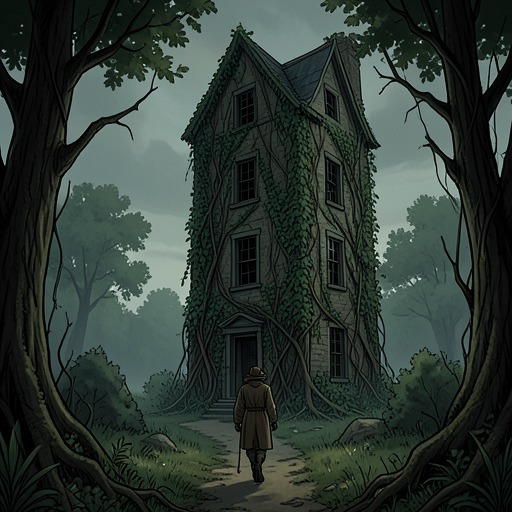
The Fall of the House of UsherSentience of the House of Usher is Roderick Usher’s theory that the mansion and its surroundings exert a powerful, possibly conscious influence over the family living within them. More than a supernatural proposition, it organizes the story’s uncertain boundary between environment and perception: the house seems to act upon its inhabitants, while their distress makes the house appear to possess a will of its own.
The Theory and Its Inheritance
Roderick’s idea emerges from a broader belief in the sentience of vegetable life, which he extends, in his disordered thinking, into the realm of inanimate matter. He associates this extension specifically with the House of Usher, proposing that its gray stones, their arrangement, the growth of fungi across them, and the decayed trees nearby have combined over a long period to produce a sentient condition. The mansion is not imagined as an isolated object. Its setting and the undisturbed persistence of its arrangement are part of the supposed cause.
Roderick also gives the theory a historical dimension. He believes that the resulting influence has shaped the Usher family’s destiny over centuries and has contributed to making him as the narrator encounters him. This claim gains force from the family’s unusual continuity: its line has produced no enduring collateral branch, and property and name have passed along a narrow line of descent. The name House of Usher consequently refers to both family and mansion. The shared name makes the family’s history and the building’s material history seem like two forms of one inheritance, although the narrator presents that connection as an interpretation rather than an established cause.
Atmosphere, Materials, and Perception
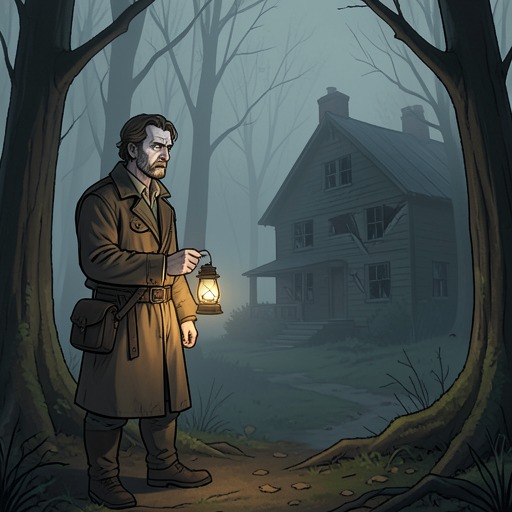
The narrator’s first encounter with the mansion supplies an experience that resembles Roderick’s theory without proving it. Arriving during a dull, dark day, he sees bleak walls, vacant windows, sedges, and decayed tree trunks, and feels an oppressive gloom that he cannot reduce to ordinary aesthetic pleasure. When he looks at the scene reflected in The tarn beside the Usher house, the inverted image intensifies rather than relieves his unease. The reflection makes the familiar arrangement appear newly estranged, binding the water visually to the building and its grounds.
The narrator briefly imagines a peculiar atmosphere rising from the decayed trees, gray walls, and still water. He recognizes that this may be a product of his own imagination, and considers whether the arrangement of ordinary features could account for the effect. Roderick’s theory later gives that impression a more definite form: he describes an atmosphere condensing around the waters and walls, and treats it as evidence of the house’s sentience. The story thus lets the same atmosphere be read in two ways—as a psychological impression and as a force belonging to the place.
Physical decay sharpens this uncertainty. The masonry remains in place, and the house appears structurally intact, although its stones are crumbling and its exterior is covered with fine fungi. A barely perceptible fissure runs from the roof down the wall toward the tarn. The combination of a seemingly stable whole and deteriorating parts makes the building resemble the family’s continued existence under the pressure of decline. The fissure is also a concrete feature that acquires greater significance when it widens during the final escape from the mansion and the building breaks apart.
Sensation and the House’s Sounds
Roderick’s physical condition makes the theory inseparable from sensory experience. He describes an extreme sensitivity to ordinary stimuli: only bland food is tolerable, certain textures of clothing are necessary, floral odors are oppressive, and even faint light torments him. Few sounds are bearable to him; stringed instruments are the exception. He also fears not danger in the abstract but the effect of events on his already intolerable agitation. His claim that the house influences him therefore comes from a person who experiences the world through unusually acute and distressing sensations.
The reading of The Mad Trist turns this sensory vulnerability into a sequence of apparent correspondences. As the narrator reads of a door being broken, he hears a distant sound that seems to echo the described action. At a later passage, the story’s dragon cry coincides with a harsh, distant sound; when the tale describes a shield falling, another muffled metallic reverberation follows. Each sound links a fictional event to an apparent event somewhere in the mansion, so that reading itself becomes a pattern for hearing and interpreting the house.
The narrator initially treats the correspondences as coincidences and does not want to intensify Roderick’s nervousness. Roderick, however, eventually reveals that he has heard movements associated with Madeline Usher for days and feared speaking of them. He interprets the sounds accompanying the reading as the breaking of her coffin, the movement of the vault’s hinges, and her approach through the mansion. The episode does not establish that the building is conscious: it shows how its rooms, sounds, and enclosed spaces provide the setting in which Roderick’s theory and fear become inseparable. The revelation of Madeline Usher’s premature burial also gives the earlier uncanny noises a concrete source within the plot.
Collapse and Interpretive Limits
The ending brings the mansion’s material condition into alignment with the family’s destruction. As the narrator flees, the fissure he had noticed at the beginning widens from roof to base; the walls separate, and the fragments sink into the water. This collapse makes the early crack seem less like incidental damage than a visible sign of a structure already under strain. The House of Usher does not merely shelter the family until its end: its final destruction coincides with the deaths of Roderick Usher and Madeline Usher and the extinction of the line.
That convergence supports the theory as a powerful organizing image, not as a settled explanation. Roderick attributes the family’s history and his condition to the house’s influence; the narrator also supplies psychological and material grounds for reading the same events without confirming supernatural agency. The atmosphere may be imagined, the sounds may be interpreted through fear, and the building’s fissure is a physical weakness. Yet the repeated correspondences—from reflection and atmosphere to sound and collapse—make it difficult to separate the inhabitants’ fate from the place. Sentience of the House of Usher is therefore effective precisely because the narrative sustains both possibilities: the mansion may seem to possess a life, or its apparent agency may be the form taken by a family’s inherited fear and decline.